
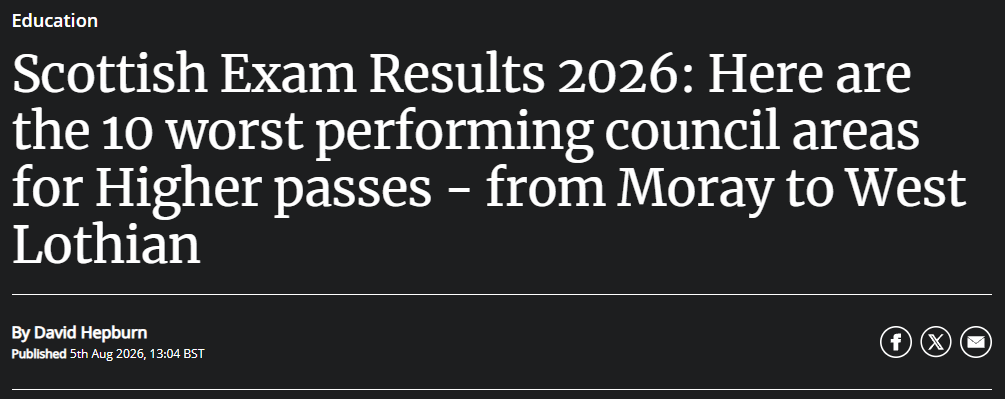
Scottish education reporting hit another low this week with The Scotsman’s latest piece of statistical rage-baiting: a page-padded countdown of Scotland’s “worst-performing” council areas for Higher passes.
We are no strangers to local news reducing complex public institutions to raw, decontextualised metrics. But pieces like this step beyond lazy reporting; they actively mislead the public while undermining the work of schools and young people across Scotland.
As a secondary teacher working outside the local authorities singled out in this piece, my objection is neither defensive nor personal. It is pedagogical and professional.
Here is why this style of reporting fails Scottish education, and why it should bother anyone who cares about honest journalism.
1. Monetising Deficit Narratives
The article follows a predictable “churnalism” template: pull a single public SQA data table, isolate the lowest numbers, attach a generic stock photo to each council area, and stretch the “listicle” across multiple web pages to maximise ad impressions.
This isn’t an investigation into educational policy or local outcomes; it’s an ad-farm structure masquerading as news. The information provided for each local authority is so sparse it borders on meaningless. A single table embedded in an actual analytical article would have sufficed. But a clear, contextual table doesn’t generate ad revenue; public shaming does.
2. Standardised Data in a Vacuum
Raw pass rates, stripped of local demographics, tell us almost nothing about school performance. Any credible education reporting must ask baseline analytical questions:
- Where is the SIMD context? How do these pass rates correlate with the Scottish Index of Multiple Deprivation (SIMD) profile of each authority? Decades of educational data proves that socio-economic status remains the single strongest predictor of exam performance. Ignoring this doesn’t hide the poverty attainment gap, it misattributes it as institutional failure.
- What about non-traditional pathways? Modern Scottish secondary education extends far beyond traditional Highers. How do these numbers account for National Certificates, Foundation Apprenticeships, and broader SCQF achievement pathways designed to serve non-academic learners?
- Where are the improvement trajectories? A council area sitting at a lower baseline while closing its internal attainment gap year-on-year is succeeding, not failing. A static snapshot ignores progress entirely.
3. The Human and Systemic Cost
Did the author reach out to any Directors of Education, Headteachers, or SQA coordinators to compare these results against predicted grades, local improvement plans, or post-pandemic recovery metrics?
Of course not. Investigative reporting requires time, effort, and sector knowledge. Aggregating numbers into a regional bottom-ten list requires none of those things.
Qualifications matter deeply. They open doors for young people and represent years of hard work by students and staff alike. But schools are complex communities tasked with pastoral care, inclusion, vocational training, and social support. Reducing an entire region’s educational ecosystem to a single metric is poor journalism, and it’s a huge disservice to the communities involved.