
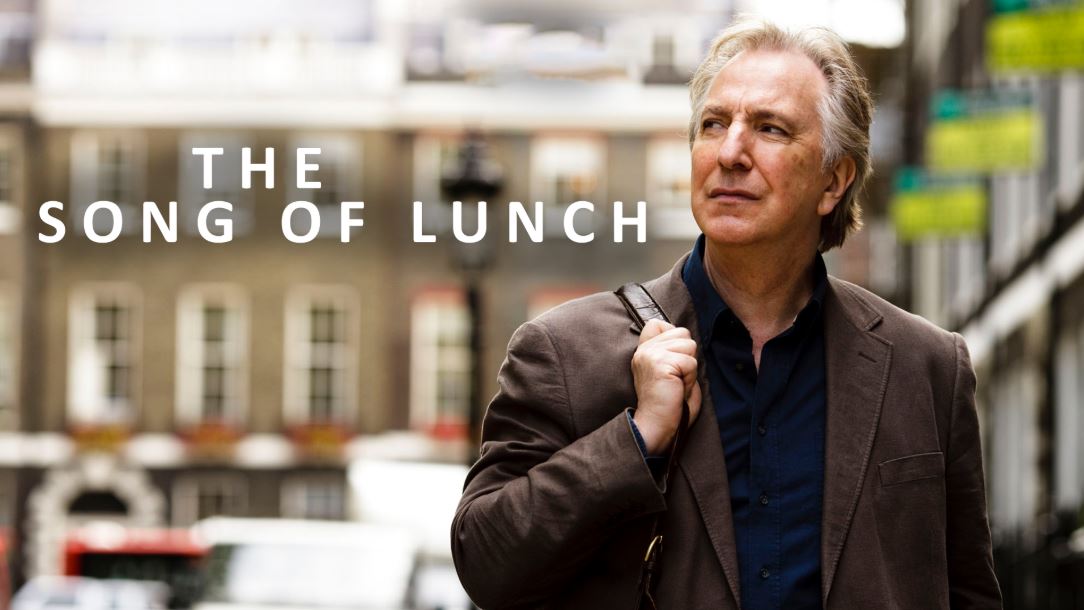
In October 2010, the BBC and Masterpiece released a television adaptation of Christopher Reid’s poem, The Song of Lunch, for National Poetry Month. It grabbed my attention right away, at the time. It seemed to me a sharp, funny, and somewhat brutal experiment. The adaptation worked, though. It worked because it leant fully into the utter strangeness of televising a poem. The result is a tight 50‑minute character study carried almost entirely by Alan Rickman’s interior monologue and Emma Thompson’s mix of warmth and painful detachment.

Rickman’s performance is the spine of the piece. His narration is at once pompous, self‑pitying, erotic, and pathetic, though really his face does half the work. You know the Rickman schtick: twitching brows, slow blinks, tiny grimaces that mirror the poem’s barbed self‑commentary.
Thompson once again reconfirms her national treasure status as she brings the necessary balance, playing the former lover with breezy tenderness and a clear sense that her life has moved on. She really hits a solid blend of frankness and sympathy.
The narration is intensely intimate, and the poem’s private thoughts become the drama. The voice‑over switches in and out of dialogue to show the gulf between what’s said and what’s felt. This structure, although risky on paper, ends up being the whole point.
This intimacy is further enhanced by the camerawork. We see extreme close‑ups, slow motion, hazy memories, and lingering shots that make every item on the table and in the surrounding restaurant feel deeply symbolic.

The film is funny in a dry, unforced way. I’m not talking about “poetry jokes” but character‑driven humour: the washed‑up writer already half‑drunk before she arrives, the irritation over a laminated wine list, the self‑inflicted misery of a man who confuses poetry with therapy.
Can I relate?
It’s also melancholic without being maudlin. The restaurant’s makeover (no more straw-swaddled Chianti bottles or checked tablecloths) becomes a visual shorthand for everything that’s changed and everything he wishes hadn’t. The final shots hammer that point home.
At just under 50 minutes, it’s deliberately slight. Some might find it indulgent or wish it were longer; I feel that the brevity kept it sharp.

But the core question must be: Does the poem survive the translation into television?
Surprisingly, yes. The adaptation preserves the poem’s rhythm and interiority while giving it a physical setting that enhances rather than distracts. The private monologue becomes a kind of second performance, and television, with its ability to cut between face, memory, and voice, turns out to be the perfect medium for this odd hybrid.
What prompted this review was my feeling the urge to rewatch The Song of Lunch, as I am partial to doing every year or two. I still have my copy, but the whole thing is available on YouTube for those who are looking to watch it for the first time:
Having rewatched it again, I can confirm that it remains a small, precise, and quietly devastating piece of work. Rickman is extraordinary, Thompson is perfectly pitched, and the direction finds a visual language for self‑loathing, nostalgia, and longing without ever tipping into melodrama. It’s not a conventional drama, and that’s just fine. It’s a poem with actors. And it works.